How to Organise Your Kitchen on a Budget
Picture the quiet satisfaction of pulling open a drawer in your rented flat or bustling family kitchen, finding exactly what you need without a rummage. A beautifully organised kitchen doesn't have to mean buying dozens of matching containers or replacing all your cupboards.
In fact, one of the best ways to organise a kitchen on a budget is to buy less, not more. Start by working out what you actually use, give everyday items sensible homes and only then consider whether a few inexpensive organisers could make the space work better.
If you have a small kitchen, overflowing cupboards or one drawer that seems to collect absolutely everything, these simple kitchen storage ideas will help you create a calmer, easier-to-use space without spending a fortune. Perfect for urban renters and busy families in compact UK homes.
1. Declutter Before You Buy Any Storage
It can be tempting to start budget kitchen organisation by ordering baskets, containers and drawer organisers. Don't, at least not yet. Storage products are much more useful when you know exactly what needs storing.
Choose one manageable area to start with, such as a drawer or cupboard. Take everything out and sort it into simple groups: Keep, Relocate, Donate, recycle or dispose of appropriately.
Look particularly closely at duplicate utensils, gadgets you rarely use, damaged items and food that's no longer suitable to keep. The less unnecessary stuff you're trying to organise, the less storage you'll need to buy.
Budget tip: Try completing the entire decluttering stage without spending anything.
2. Organise Your Kitchen into Zones
Once you've decided what you're keeping, think about where you actually use each item. Creating zones can make a kitchen much easier to navigate, especially in small kitchen organisation scenarios.
- Tea and coffee zone: Keep mugs, tea, coffee and other regularly used supplies together and, where practical, close to where you prepare drinks.
- Cooking zone: Keep frequently used utensils, pans and cooking essentials within convenient reach of your main preparation and cooking area.
- Baking zone: Group baking tins, measuring equipment and other baking essentials together.
- Food storage zone: Keep reusable food containers, lids, wraps and similar items in one designated area.
The goal isn't to make your cupboards look perfect. It's to reduce the amount of searching and moving around you have to do.
3. Use What You Already Own
Before buying organisers, look around your home. You might already have small baskets, trays, boxes, glass jars, containers, magazine holders and small tubs.
A small box can separate packets in a cupboard. A spare tray can contain oils or condiments. A jar can hold frequently used utensils.
Repurposing what you already own is one of the easiest ways to organise a kitchen on a budget. You can always upgrade later if the system works well.
4. Divide Messy Kitchen Drawers
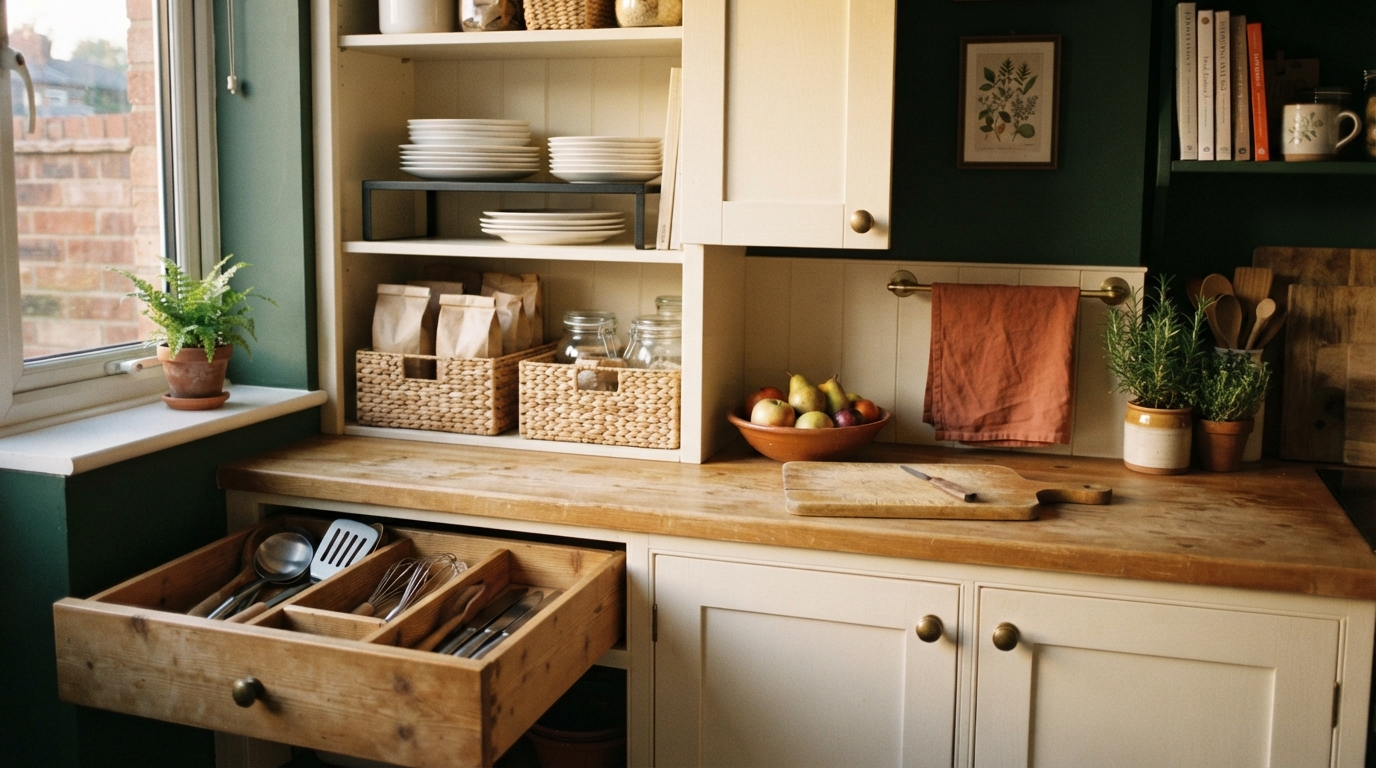
The cutlery drawer usually has some kind of divider. The rest of our kitchen drawers? Not always. Large, undivided drawers quickly become messy because everything moves around whenever they're opened.
Consider separating categories such as cooking utensils, baking tools, food clips, measuring spoons, foil and food-storage products, and small kitchen accessories.
You don't necessarily need a divider for every object. The aim is simply to stop unrelated things becoming one big pile.
If you are after a popular divider, we would recommend looking at the Amazon UK search for kitchen drawer dividers. Disclosure: links open Amazon UK search results so readers can compare options; Room to Breathe does not currently earn commission from these links.
5. Make Better Use of Cupboard Height
One of the biggest kitchen storage ideas for small spaces isn't always a lack of cupboards. It's unused space inside them. If there's a large gap between a short stack of plates and the shelf above, for example, a suitable shelf riser may let you use that vertical space more efficiently.
They can be useful for plates, bowls, mugs, tins and packaged foods. Before buying one, measure the cupboard carefully, including its width, depth and available height.
If you are after a shelf riser, we would recommend looking at the Amazon UK search for kitchen shelf riser.
6. Use Baskets to Create Categories
You don't need a pantry worthy of a magazine shoot. A few simple baskets or containers can stop smaller items disappearing into the back of a deep cupboard, ideal for kitchen cupboard organisation.
- Breakfast: oats, spreads and other breakfast staples.
- Snacks: keep packaged snacks together.
- Baking: decorations, raising agents, flavourings and other smaller baking supplies.
- Sauces and packets: group smaller packets that otherwise tend to get lost.
You don't have to decant everything into matching containers either. Keeping products in their original packaging can be cheaper and easier.
If you are after popular baskets for kitchen cupboards, we would recommend looking at the Amazon UK search for kitchen cupboard storage baskets.
7. Tackle the Under-Sink Cupboard
The cupboard beneath the kitchen sink has a remarkable ability to become chaotic. Pipes make the space awkward, bottles are different sizes, and smaller items can disappear behind larger ones.
Start by emptying the cupboard completely and cleaning it. Then group together the products you intend to store there. Depending on your cupboard and what can safely be stored in it, you might find it useful to use separate containers for different categories. A portable cleaning caddy can also make frequently used cleaning supplies easier to carry from one area to another.
When choosing organisers, remember to measure around pipework rather than assuming a product will fit. Popular choices for under-sink storage: Amazon UK search for under sink storage organiser, and Amazon UK search for under sink cleaning caddy.
Safety note: Always follow product labels and manufacturer instructions for the safe storage of household cleaning products, particularly in homes with children or pets.
For a full step-by-step makeover, see the related piece: How to Organise an Under-Sink Cupboard.
8. Keep Your Worktops as Clear as Possible
You don't have to remove absolutely everything from your kitchen worktops. But reducing visual clutter can make even a small kitchen feel calmer, especially in busy family homes.
Ask yourself: Do I use this most days? If the answer is no, consider whether it needs to live on the worktop. Appliances and utensils used every day may deserve that valuable space. Items used occasionally could potentially live in a cupboard instead.
A clear worktop also gives you more usable preparation space, which is far more valuable than having storage products simply for decoration.
9. Store Similar Food Together
Organising food into broad categories makes it easier to see what you have before shopping. You could group pasta and rice, tins and jars, breakfast foods, baking supplies, snacks, and herbs and spices.
There's no requirement to transfer everything into expensive matching containers. If a £1 basket keeps your pasta packets together perfectly well, you've solved the organisational problem.
Choose storage because it makes the space function better, not simply because it looks attractive online. Affordable kitchen storage starts with practical choices.
10. Create a System for Food Containers and Lids
Food-storage containers can quickly take over a cupboard. Start by matching every container with its lid. If you have orphaned lids or containers that are damaged or no longer suitable for use, deal with those before reorganising the rest.
Then try nesting compatible containers, keeping lids together, storing similar sizes together, and giving the entire category a defined amount of space.
A dedicated lid organiser can be useful if loose lids are a persistent problem, but try a box or basket you already own first. Amazon UK search for food container lid organiser.
11. Don't Organise Things You Don't Need
This sounds obvious, but it's one of the easiest mistakes to make. If you have 15 mugs but regularly use six, buying a larger mug organiser might not be the best solution.
The same applies to water bottles, food containers, reusable shopping bags, baking equipment, utensils and cleaning supplies. Before asking, “How can I store all of this?”, ask: “Do I actually need all of this?” Decluttering is free storage.
12. Make Your Organisation Easy to Maintain
An organisation system isn't particularly useful if it takes 20 minutes to reset every evening. Keep things simple. Frequently used items should generally be among the easiest to access and put away. Try to avoid systems where you have to move five containers to reach something you use every morning.
After organising an area, use it normally for a week. Then ask: Is everything easy to find? Is it easy to put away? Have I created unnecessary steps? Does anyone else using the kitchen understand the system? Is clutter already starting to return? If something isn't working, change it. Your kitchen needs to work for your household, not for a photograph.
How Much Does It Cost to Organise a Kitchen?
Potentially, very little. Start with a £0 organisation challenge: Declutter. Rearrange items into useful zones. Repurpose containers you already have. Live with the new arrangement for a few days. Identify the remaining storage problems. Buy only the organisers that solve those specific problems.
If you decide to spend money, set yourself a budget before shopping, perhaps £20, £30 or whatever is realistic for you. A handful of carefully chosen products will usually be more useful than a basket full of organisers purchased without a plan.
FAQ
How can I organise my kitchen cheaply?
Start by decluttering and rearranging what you already own before purchasing storage. Repurpose boxes, baskets, jars and trays where appropriate, and only buy an organiser when you've identified a specific problem it will solve.
How do I organise a small kitchen with limited storage?
Prioritise the things you use most, reduce unnecessary duplicates and look for unused vertical space inside cupboards. Keeping worktops relatively clear and grouping similar items together can also make a small kitchen easier to use.
Should I buy storage containers before organising?
Usually, no. Declutter first, decide where everything will live and measure the available space. You'll then have a much better idea of whether you need additional storage and what dimensions will actually fit.
How do I keep my kitchen organised?
Make items easy to return to their designated places. Avoid overly complicated systems, periodically remove things you no longer use and give problem areas a quick reset when clutter begins to build.
Is it worth buying matching kitchen storage containers?
Only if they solve a genuine storage problem and suit your budget. Matching containers can look attractive, but they aren't necessary for an organised kitchen. Function should come first.
Where should I start when my whole kitchen is cluttered?
Start small. Pick one drawer or one cupboard rather than emptying the entire kitchen at once. Complete that area, then move to the next. Small wins make a larger kitchen organisation project much more manageable.
A More Organised Kitchen Doesn't Have to Cost a Fortune
Organising a kitchen on a budget starts with being intentional about what you keep and where you keep it. Declutter first. Organise second. Shop last.
Start with one drawer or cupboard today. Use what you already have, see what works and only spend money where a product will genuinely make the space easier to use. A practical kitchen doesn't have to look perfect. It simply needs to work for you, bringing a sense of calm to busy days in your home.
Continue organising your home:
Read next: How to Organise an Under-Sink Cupboard
You may also like: 15 Small Kitchen Storage Ideas That Actually Save Space
You may also like: 20 Affordable Storage Ideas That Actually Work
